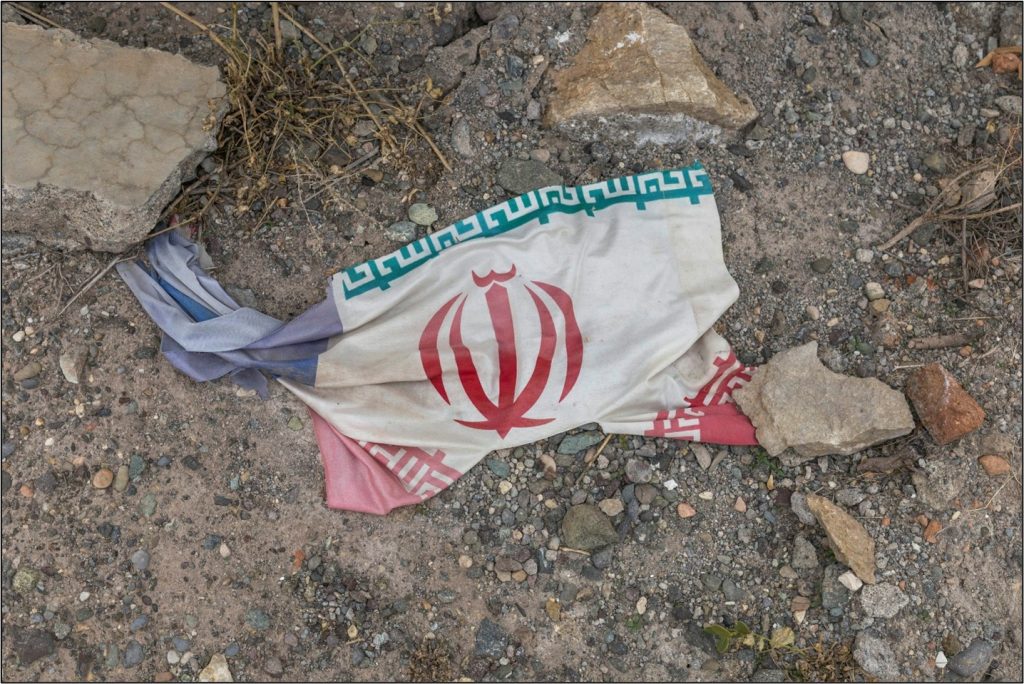
Cover Image: Unsplash (Javad Esmaeili)
Iran’s protest wave began with an economic shock that hit the country’s commercial core. When bazaar merchants, long a stabilizing pillar of the Islamic Republic, closed their shops in late December 2025, they transformed currency collapse and price volatility into a nationwide political crisis. The bazaar’s shift marked a historic rupture in its alliance with the clerical establishment, accelerating the spread of protests and deepening the regime’s legitimacy problem. Yet despite the scale and symbolism of bazaari action, the conditions for a 1979-style revolution may not be fully in place: the clergy remains fragmented, the security forces, especially the IRGC, remain cohesive, and repression continues to contain, though not resolve, unrest. Iran may thus be entering a prolonged period of instability rather than an imminent transition.
From Bazaar Strikes to Uprisings
Iran’s protest wave began in late December 2025 with a shock that hit the country’s commercial core. On 27–29 December, the Iranian rial plunged past a series of psychological thresholds, collapsing to roughly 1.44–1.46 million rials per US dollar. In 2025 alone, the currency lost nearly half its value, while official inflation reached 42.5% in December. For merchants in Tehran’s Grand Bazaar and adjacent markets, already squeezed by sanctions, shortages, and the dominance of the Islamic Revolutionary Guard Corps (IRGC) over trade and foreign currency, this volatility made regular business extremely difficult. Shopkeepers began shuttering their stores, staging strikes in Tehran’s Grand Bazaar sections of Bein-ol-Haramein, Kaffashha Bazaar, the Gold and Jewelry Bazaar, Pachenar, Hammamchal, and surrounding commercial arteries.
What started as an economic protest quickly escalated. The central bank’s decision to end a preferential exchange-rate scheme for some importers led to sharp price increases for basic goods, with some items disappearing from shelves altogether. Within 72 hours, merchant strikes spread beyond Tehran to 21 of Iran’s 31 provinces, and by early January, demonstrations had reportedly reached more than 180 cities and towns nationwide. The government attempted to contain the unrest with limited concessions, including cash handouts of about USD 7 per person per month, but these measures failed to calm anger driven by collapsing purchasing power and price volatility.
On 6 January 2026, Tehran’s Grand Bazaar became a central flashpoint. Security forces clashed with protesters staging a sit-in inside the largely shuttered complex, firing tear gas and forcibly clearing demonstrators from a site historically synonymous with mass mobilization during the 1979 Islamic Revolution. Rights groups reported at least 35–36 deaths and more than 1,200 arrests by that point, as protests spread to further locations. Chants shifted rapidly from economic grievances to direct political defiance, including slogans such as “Death to Khamenei.”
As repression intensified, the information environment grew increasingly dark. A near-total internet blackout lasting over 100 hours made verification difficult and obscured the scale of violence. By 13 January, an Iranian official told Reuters that around 2,000 people, including security personnel, had been killed since protests began in late December, a figure far higher than earlier counts by the US-based Human Rights Activists News Agency, which had documented 646 deaths (512 protesters and 134 security forces) and over 10,700 arrests. Reports from late January suggest that the death toll rose to roughly 6,479, with over 17,000 cases still being under review, and some reports suggesting a death toll of up to 36,500 nationwide.
As the crackdown ultimately brought the protests to a temporary halt, and President Donald Trump initially stepped back from his late-January threat to attack Iran, it became increasingly clear that the movement had originated in the bazaars. When the regime’s oldest commercial ally closed its shutters, a localized economic revolt became the most serious nationwide challenge the Islamic Republic has faced in years.
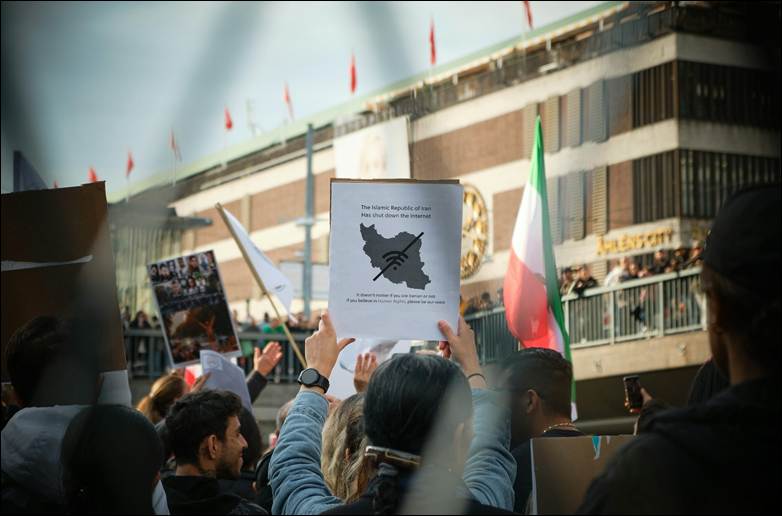
Source: Unsplash (Artin Bakhan)
The Modern History &Importance of the Bazaar
For over a century, Iran’s bazaars have been far more than commercial spaces. They function as autonomous social and political institutions where trade, religion, information, and collective action meet. Historically, the bazaar has been difficult for the state to fully control, and it has long served as a marker of political stability: when it closes, the regime faces issues.
The bazaar’s influence was anchored in its alliance with the Shiite clergy. Merchants financed mosques, religious schools, and clerical networks through donations and religious taxes, while clerics provided legitimacy, protection, and mobilizing authority. This partnership shaped pivotal moments in modern Iranian history, from the 1890 Tobacco Protest and the 1905–1910 Constitutional Revolution to support for Mohammad Mossadegh in the early 1950s. It reached its peak during the 1979 Islamic Revolution, when bazaar shutdowns and merchant-funded strike committees sustained mass mobilization and provided the financial backbone that helped topple the monarchy.
After 1979, bazaaris expected political influence in return. For much of the 1980s and 1990s, they partially received it. Through conservative networks such as the Islamic Coalition Party, prominent merchants gained access to state power and benefited from preferential import licenses, subsidized exchange rates, and influence over commercial institutions. The bazaar remained one of the Islamic Republic’s most dependable pillars.
This position began to erode in the 2000s. Under President Mahmoud Ahmadinejad, “privatization” policies transferred major state assets not to private merchants but to entities linked to the IRGC and large bonyads. Sanctions accelerated this shift: sanctions-evasion networks, control over ports, logistics, and key industries moved economic power toward the IRGC, steadily marginalizing traditional merchants.
Signs of rupture appeared as early as 2008, when merchants staged strikes for the first time since the revolution. At the time of writing, the bazaar’s renewed activism marks perhaps a more profound shift. Reportedly still controlling roughly 40% of Iran’s consumer-goods distribution and financing schools, mosques, charities, and clerical networks, the bazaar’s defiance signals not a temporary economic protest, but the steady fracture of a historic alliance that once underpinned the Islamic Republic.
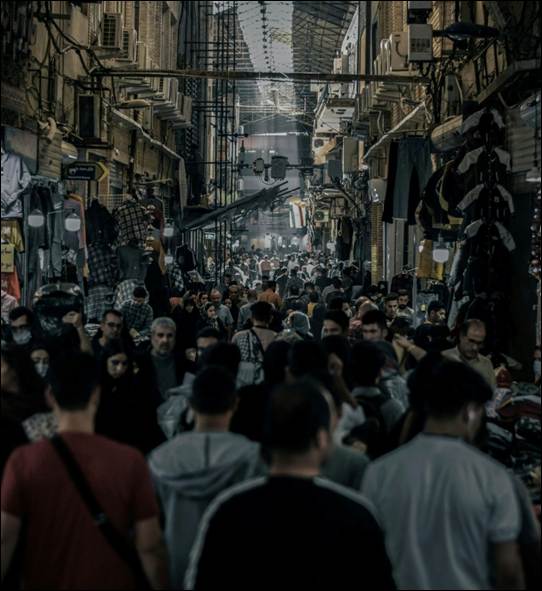
Source: Unsplash (Mahdi Molaee)
What Bazaari Action Reveals About the Protests
The centrality of the bazaar in this protest wave revealed both the depth of Iran’s economic decline and the extent to which parts of the Islamic Republic’s traditional support base may be eroding. The bazaar’s defiance is not a sudden ideological conversion but the culmination of years of marginalisation, as merchants have found themselves pushed to the economic periphery. Supreme Leader Ali Khamenei attempted to preserve the old social contract by distinguishing between what he called the bazaar’s “legitimate” economic grievances and what he branded as “rioting.” Yet this narrative has broken down on the ground. Strikes and sit-ins inside Tehran’s Grand Bazaar and elsewhere across the country, met with government repression, suggest that merchants are increasingly questioning whether their economic survival can be sustained under the current system of authority.
What makes bazaari participation especially revealing is its traditionally conservative logic. Bazaar merchants have historically prioritized order, predictability, and stability over political confrontation. Their power has rested on economic leverage, including collective shutdowns, pricing control, and dense social networks that link traders, workers, clerics, and consumers. When such actors decide to close shop, it signals that routine commerce has become near impossible. Interviews with traders underscore that the immediate trigger is not inflation alone, but rather extreme price volatility, an inability to know whether restocking today will lead to bankruptcy tomorrow.
The bazaar’s action also exposed a structural shift in power. Over the past two decades, the IRGC has displaced traditional merchants by dominating imports, currency access, ports, and sanctions-evasion networks. Bazaaris now find themselves dependent on, or excluded by, IRGC-linked firms that control oil revenues, logistics, and trade routes. As a result, their protest may not have been merely against prices, but against a political economy in which they no longer have agency. This explains why economic grievances have rapidly turned political: once stability itself disappears, loyalty loses its value.
Crucially, bazaar shutdowns have served as accelerants. Within days, merchant strikes spread across provinces and intersected with student protests, labour actions, and pensioner demonstrations, forming a rare cross-sector coalition. The scale of repression, reportedly hundreds killed and more than 10,000 arrested, underscores how seriously the regime views this break. In this sense, bazaari action is a clear signal that a constituency once central to regime stability now increasingly views the current system as a threat.
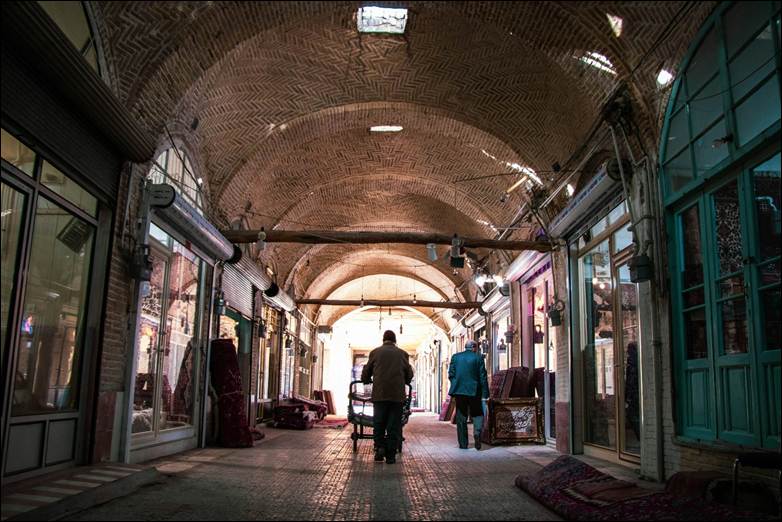
Source: Unsplash (Parastoo Maleki)
What is Next?
The scale and symbolism of bazaar participation have fueled speculation that Iran may be approaching a revolutionary moment. Recent analyses, including those that mention the “five pillars of revolutions” framework, argue that Iran soon meets many historical conditions associated with regime collapse: a severe economic crisis, elite fragmentation, a broad opposition coalition, a shared narrative of resistance, and an unusually hostile international environment. On several of these fronts, the bazaar’s defection matters. Its strikes helped ignite nationwide unrest, linking economic collapse to political failure and widening the protest base beyond students and activists to traditionally conservative constituencies.
Yet, as Narges Bajoghli cautions, this moment is not 1979. The bazaar no longer wields the autonomous economic power it once did. Decades of sanctions, privatization, and the rise of the IRGC’s commercial empire have left many merchants dependent on regime-linked networks for imports, credit, and survival. This dependence limits how far bazaaris are willing, or able, to push confrontation. Their demands remain essentially pragmatic: stability, predictability, and relief from the current economic system. As several merchants have noted, they want change, but not chaos. This helps explain why authorities were able, through pressure and intimidation, to force parts of Tehran’s Grand Bazaar to reopen even as protests continued elsewhere.
More broadly, other pillars required for revolution remain uncertain. The clergy is deeply fragmented, rather than unified against the state, with decentralized power, unequal resources, and competing political visions. This means there is no unified Islamic Republic, but rather rival religious power centers that could either fracture or regroup under pressure. Most decisively, there is no evidence of defection within the security forces. The IRGC remains cohesive, economically entrenched, and politically invested in the regime’s survival. As long as it continues to enforce repression, it remains the system’s ultimate guarantor.
External pressure further complicates the outlook. Foreign intervention may heighten regime anxiety and weaken deterrence, but it also reinforces Tehran’s narrative of foreign interference, thereby risking the justification of harsher crackdowns. This may derail domestic momentum rather than accelerate change.
In short, sustained bazaar opposition deepens the regime’s legitimacy crisis, but on its own, it is not decisive. A revolutionary outcome would still require alignment across multiple power centers.
Source: Unsplash (Lukas Menzel)
The protests underscored how the Islamic Republic’s social foundations have begun to erode, but they also highlighted the limits of revolutionary momentum under current conditions. The actions of bazaaris signal a historic rupture in an alliance that once anchored clerical rule, transforming economic collapse into a broader legitimacy crisis. Yet unlike 1979, today’s crisis unfolds within a fragmented power structure. The clergy is divided, lacking a unifying figure or shared vision that could translate unrest into an alternative political order, while the IRGC remains cohesive and deeply invested in preserving the status quo. This combination creates a volatile but indeterminate moment: pressure may splinter elite factions and deepen instability, but it may also prompt partial reconsolidation through repression and selective concessions. Iran thus appears caught between a sustained crisis and stalled transformation, where collapse is imaginable, reform is elusive, and revolution is possible but far from inevitable.
In moments of intense social unrest, such as those unfolding in Iran, reliable and comprehensive research grounded in trusted local sources is essential for understanding the complex dynamics on the ground and avoiding misreading signals.